The One-Dinner Experiment: What Happened When the Kids’ Menu Closed
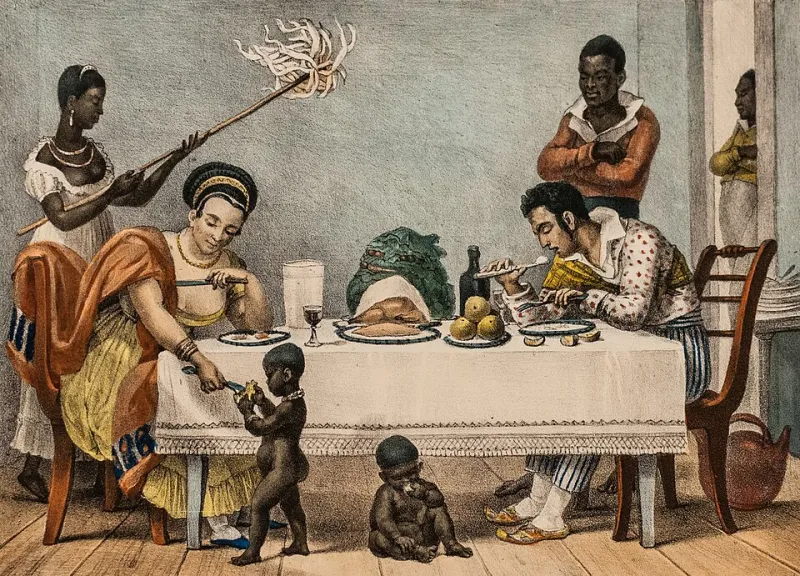
Photo: Jean-Baptiste Debret, Public domain, via Wikimedia Commons
For a long time, our kitchen had two settings: children’s tea and grown-up dinner. At 5pm there were fish fingers, peas and a pile of pasta that had to be plain — not saucy, not green, not suspiciously garlicky. At 8pm, once the kids were finally down, my partner and I ate something with actual seasoning and talked in sentences. It worked, sort of. It also meant I cooked twice, washed up twice and spent half my weekly shop buying two versions of tea.
Last autumn, I decided I’d had enough. Not in a dramatic, flung-oven-gloves way. More in a quiet, spreadsheet-and-tiredness way. The food bill had crept up, the fridge was full of half-used ingredients and I was fed up of being a short-order cook in my own home. So we tried something radical: one dinner for everyone.
I would love to tell you it was a serene transition. It was not. The first week featured a lot of sighing, one child eating only bread, and a standoff over a single green bean that I suspect is still talked about in our house. But we kept going. Six months on, we are not a perfect family-meal family. We are, however, a one-dinner family most nights — and that has changed more than our food bill.
What actually got eaten
The first thing I learned is that children are not reliable witnesses to their own food preferences. My youngest announced she hated curry, then ate two servings of a mild chickpea number when it was served with rice and a bit of yoghurt on the side. My eldest claimed she only liked pasta with butter, then quietly demolished a bowl of tomato and lentil sauce when there was no alternative on offer. Not every night. But often enough to make me rethink the whole ‘they won’t eat it’ script.
We did not go from fish fingers to a full Sunday roast overnight. We built a small rotation: sausage traybake with peppers, mild dhal with rice, pasta with a sauce that can be served on the side, fajitas where everyone assembles their own, a roast chicken that becomes sandwiches and soup. Some nights it is beans on toast for everyone, because I am a parent, not a restaurant.
What got eaten most reliably was food that could be deconstructed. A plate with rice, sauce, veg and protein separate is less threatening than a bowl of stew. It also means a child can leave the sauce, eat the rice and still sit at the table without a full-scale negotiation. I stopped seeing that as a defeat. It is just dinner.
Where the money went
I am not going to pretend one family meal saved us hundreds of pounds. It did not. But the weekly shop got simpler. We stopped buying separate ‘kids’ food’ — the shaped nuggets, the mini pizzas, the individual yoghurts that cost more per gram than cheese from the deli. We wasted less, because leftovers became lunch rather than sitting in a tub until they turned into a science experiment.
The biggest saving was time. Cooking once, clearing once, and not starting a second shift at 8pm added up to something that felt almost luxurious. We ate earlier as a family, which meant the kids were less overtired and we were less likely to spend the evening scrolling in a fog of dirty pans. That is not a financial saving, but it is a real one.
The emotional bit
Here is the part nobody warns you about: ending the two-dinner system brought up a lot of baggage. My own childhood was full of ‘eat what’s on your plate’ and ‘there are children starving in the world’. I did not want to recreate that pressure, but I also did not want to spend every teatime pleading with a small person to try a mushroom.
We had to separate the food from the feelings. A child refusing a meal is not a rejection of me as a parent. It is a child saying ‘this tastes weird’ or ‘I’m tired’ or ‘I wanted to be playing’. I had to stop treating the dinner table as a test of my worth. That was harder than any recipe.
We also had to agree as adults that we were not going to swoop in with a replacement meal every time someone pushed their plate away. There is always a piece of fruit or some bread and butter available. That is the safety net. It is not a second dinner.
Tactics that helped
If you want to try one family meal, I would start with a low-stakes night. A pasta dish, a traybake, something you know at least one child will tolerate. Serve it family-style and let people help themselves. Put sauces and dressings on the side. Keep a plain carbohydrate and a raw vegetable on the table — not as a reward, just as a landline.
Pick your battles. I do not force a clean plate, and I do not make a separate meal. I do ask that everyone sits down for a few minutes. Some nights that is five minutes and a lot of moaning. Other nights it is a proper chat about school, football or whether a dog could theoretically drive a car.
Batch cook when you can. A big pot of sauce freezes well and makes the next one-dinner night feel less like a production. Involve the kids in choosing one meal a week. They are more likely to eat something they picked, even if they picked it for the wrong reasons.
Most of all, I have stopped expecting every dinner to be a triumph. Some meals are a success if everyone is fed and nobody cries. That is not a low bar; that is realistic family life. The kids’ menu is closed. The kitchen is not a restaurant. And tea-time, most nights, is finally just tea-time.